By Medical Solutions

March 11, 2026

290 Views

ADVERTISEMENT

Changing Travel Nurse Specialties: A Step-by-Step Guide

Thinking about changing travel nurse specialties? You’re not the only one. A lot of travelers hit a point where they’re ready for a different pace, a new patient population, or just a fresh challenge. The tricky part is that hospitals usually hire travelers to step in fast, so switching travel nurse specialties takes a little strategy. Here’s what you need to know (and what to do next) to make the move without putting your travel career on hold.

Why Travel Nurses Want to Change Specialties

Most specialty switches come down to a few common themes:

  • You’re ready for a change in pace or stress level. Maybe you love your unit, but you want something more sustainable.
  • You found a specialty that actually fits you. Travel exposes you to different workflows and teams, so sometimes you discover a unit you wish you’d tried sooner.
  • You want more options and better match opportunities. Adding a specialty can expand the types of travel nurse jobs you qualify for.
  • You’re thinking long-term. Some travelers pivot toward future goals, such as advanced practice plans, leadership, outpatient schedules, or a specialty they want to “settle into” later.

The Biggest Obstacle When Changing Travel Nurse Specialties

Many facilities want travelers who can safely function with minimal ramp-up, so recent specialty experience is often a hard requirement. It’s common to see job posts asking for 1–2 years of experience in the specialty and sometimes specifically within the last year.

That doesn’t mean you can’t switch. It means you’ll likely need to build a bridge so your experience looks like a confident yes instead of a risky maybe.

How to Change Travel Nurse Specialties

If you’re aiming for a new specialty, the fastest path is a plan that builds experience in the right order. These steps will help you choose bridge opportunities, meet common requirements, and make your resume reflect your readiness.

1) Start with a Skills Overlap Checklist

Before you chase a completely new lane, identify what already transfers. Make a quick list of:

  • Patient acuity you’re used to
  • Procedures/skills you can do confidently
  • Common medications and equipment you know well
  • Experience floating, taking admissions/discharges, precepting, charge support, etc.

Then compare that to your target specialty. The more overlap you can clearly explain, the easier the switch tends to be.

2) Consider Roles that Bridge the Gap

This is where most successful specialty switches happen. Instead of jumping from Point A to Point Z, aim for Point B first. For example, med-surg to tele/stepdown if you already manage complex patients, or ICU to PACU, as they both often align with strong critical thinking and fast pace. You can also build experience through local PRN/per diem, internal cross-training, or floating opportunities on your current assignment.

3) Get the Right Certifications

Certifications don’t replace experience, but they can make you more competitive and show you’re serious.

While certifications vary by facility and assignment, some include:

  • ACLS (often expected for ICU/tele/stepdown, sometimes ED/PACU)
  • PALS (peds settings and some ED roles)
  • NRP (newborn/NICU/L&D environments)
  • TNCC (often valued for ED/trauma)

Focus on what your target specialty actually expects, not what looks impressive on paper.

4) Find Someone Who Could Mentor You

A quick conversation with the right person can save you months of guessing. Ask a nurse in your target specialty:

  • What experience do facilities really want to see?
  • What felt hardest in the first 2–4 weeks?
  • What skills should you practice before you apply?

Even one mentor can help you pick smarter bridge steps.

5) Update Your Resume to Show You’re Ready

Hiring teams move fast. Help them connect the dots by highlighting:

  • Unit types and acuity
  • Ratios and core responsibilities
  • Transferable skills (drips, vents, lines, wound care, triage, procedural support, etc.)
  • Floating experience and how quickly you onboard
  • Certifications
  • Recent, relevant experience first

Your Next Chapter in Travel Nursing

Changing travel nurse specialties can feel like starting over, but it’s really just building a new lane. Put a simple plan behind your goal, rack up recent experience, and you’ll be surprised how quickly “maybe someday” turns into your next contract. And don’t do it solo: a good travel nursing agency and recruiter can help you map out bridge assignments, target the right facilities, and position your resume so you’re competitive for travel nurse jobs in your new specialty.

Ready for your next step? Explore travel nurse jobs on The Gypsy Nurse job board and find assignments that match your growing skill set.

By CareerStaff Unlimited

May 8, 2024

4990 Views

ADVERTISEMENT

7 Ways to Level Up Your Travel Nursing Resume

CareerStaff Unlimited provided this article.

Are you inspired by this year’s National Nurses Week and its message of making a difference? Or maybe you’re just wondering how to take your nursing career in a more satisfying direction. With travel nursing, discover one of the best ways to supercharge your travel nursing resume!

Traveling has long been a go-to option for nurses looking for brighter job prospects. But today, as competition for the best jobs gets more intense, travel offers more value than ever. Discover seven easy ways to level up your travel nursing resume and get the most out of each travel experience. 

travel nursing resume

How Can Traveling Help Your Nursing Career?

You probably already know some of the limitless benefits of traveling. As a nurse, if you’re willing and able to travel, you’ll unlock many more job opportunities. Plus, you’ll unleash your potential for higher pay and the chance to work where and when you want. There’s a good reason why it’s often considered one of the best jobs for work-life balance!

For those who love adventure, traveling also opens the door to exploring new parts of the country while your employer or agency foots the bill for pesky expenses. For example, housing and transportation. Best of all, traveling helps your career by showing future employers that you’re versatile, reliable, and adaptable. 

However, travel nursing is also a game-changer for your career, with the chance to add specific skills to your resume that many other nurses simply don’t have.

Tips to Level Up Your Travel Nursing Resume

Travel nursing can help your resume in many other ways too, but it’s often up to you to get the most of those benefits! With that in mind, here are seven tips to take your traveling game — and career prospects — to an entirely new level. 

#1: Work in a new facility. 

From huge hospitals and health centers to nursing homes or post-acute rehab centers, the list of facilities that hire nurses may be longer than you think. Travel nursing gives you the chance to work in a variety of facilities, which can make your travel nursing resume much more appealing than nurses with less diversity of experience. 

#2: Work in a new setting. 

Working in a different department or unit as a travel nurse can be a game-changer for your travel nursing resume. For instance, doing so gives you experience working with more patients, condition types, and fellow care providers. It also shows that you can handle a wide variety of clinical treatments and methodologies, as well as technologies, EHR systems, and more.

Pro Tip: Add these new skills to your travel nursing resume!

#3: Join an association. 

travel nursing resume

The certifications you need to land certain jobs or work in some specialties are usually offered by a specific organization. For instance, becoming a Certified Pediatric Nurse (CPN) means following the guidelines of the Pediatric Nursing Certification Board (PNCB). 

Joining some of the top nursing organizations can help you earn certifications and put them to the best use. Bigger groups like the American Nurses Association (ANA) can also help you get more from traveling by offering insider job info, a nationwide support group, and the chance to build closer relationships with members while on assignment.

#4: Focus on professional development. 

In some travel nursing jobs, you can earn certifications and continuing education (CE) credits to add to your travel nursing resume. You can also sync up an assignment with a conference or event you want to attend — the Annual Meeting of the ANA Membership Assembly, for instance.

#5: Focus on cultural competence. 

Working in new regions or settings can put you in direct contact with people from different backgrounds, cultures, and even languages. This experience can help give you a competitive advantage with future nurse employers. Therefore, if you usually work in cities, consider an assignment in a rural area (or vice-versa) to expand the cultural impact you get from traveling!

#6: Network.

Smart travelers make a point of meeting new people at each assignment. Networking offers the personal fulfillment of making new friends and advancement opportunities like references and insider job tips. Plus, having more colleagues in your network boosts your chances of scoring the referral bonuses offered by many recruiters.

#7: Find a recruiter who cares. 

Lastly, the travel jobs you land are only as good as the recruiter who finds them. Therefore, connect with the jobs best suited to your needs and resume skills by working with a travel nursing recruiter who does the extra work to understand your ultimate goals.

Expand Your Resume and Career with Travel Nursing

Ready to level up your travel nursing resume? When it’s time to find your next assignment, it’s important to choose a trusted agency like CareerStaff to connect you with the very best opportunities and recruiters.

We hope you found this article on 7 ways to level up your travel nursing resume helpful. Are there any other things you think should be included on your travel nursing resume? Comment them below.

Happy Nurses Week from CareerStaff!

Find Your Next Travel Nurse Assignment with Our Job Board!

Are you on the hunt for your next travel nurse gig? Look no further than our job board! Click here to explore all our current opportunities.

Discover the Perfect Housing for Your Next Assignment

Do you need somewhere to stay on your next travel nurse assignment? We’ve got you covered. Check out our housing page to find your ideal home away from home. Click here to start your search.

By Leslie Catalano

June 19, 2022

6559 Views

ADVERTISEMENT

Build a Killer Travel Nurse Resume

Travel nurses are in a unique position where it is acceptable – even expected – to change your job every 13 weeks, but when it comes to building a resume, it can be not easy to figure out how to organize all the different jobs. I chatted with Sarah Bricker, a human resource specialist for 10 years, and Valarie LeSeure, a career counselor for 12 years, and we came up with four key ideas for creating a top-notch travel nurse resume.

Make sure your contact information is up to date.

As a traveler, your address may change before you even have a chance to unpack the last box, so it is important to have a home base and use that address on your resume. Many travel positions (although there are more local travel positions lately) are based on your location. Many times, to be considered a traveler, you must travel 50 miles outside your home base. This is also important for certain tax benefits. If you are not quite outside the 50 miles, the hospital may be able to let you know.

And, of course, make sure your phone number is accurate. With cell phones, this is not as much of an issue, but if you ever change your phone number, be sure to update your resume.

Also, use a professional email. You do not have to purchase a fancy new email. Just create one that sounds professional if you do not already have one. My first email, back in high school, was created from a nickname. Not a name I would want to put on a professional resume. Using your first and last name is professional. If you want to make it more memorable or unique, you can add a catchy word or two, for example, YourNameTravelRN@emaildomain. Whatever you decide to go with, make sure it is something you are proud to displace on a professional resume.

Organize jobs based on travel agencies if possible.

From a human resource perspective, Sarah Bricker recommends listing your jobs by the travel agency you are working with. I know many travelers use several different agencies to ensure the best rates, which is important, but if you can organize them by just a few companies, this can help you in two ways. One, it will shorten your resume from potentially 20 pages to just a few. Two, it shows commitment and longevity. Your individual assignments may only be 13 weeks, but if you can show you have been with the same company for a while, Sarah Bicker explains, “it shows commitment, employer loyalty and most importantly resiliency since healthcare is changing so rapidly.”

 In my own previous role as a hospital educator, the hospital I worked for would hire the same travel nurses over and over. Many travel nurses would work the maximum allowed time to be considered a traveler (many times, this is around a year but check with a tax specialist), then go work a travel job at another hospital and come back. This way, they never lost their status as a travel nurse and were able to come back to a familiar hospital over and over. This type of arrangement would be great for someone who prefers more consistency while still wanting to reap the benefits of being a travel nurse.

Highlight the skills that will be needed in your next position.

Look at the job description and highlight your skill set to match the description. For example, if you are applying for a cardiac unit, show all the jobs in which you worked with cardiac patients. Include your ability to read cardiac stripes and add any certifications that show your skills as a cardiac nurse. Valarie LeSeure also states, “you would want to stress adaptability, preparation, and willingness to venture into unknown territory.” You must make sure your skill sets match the job you are applying for and show your willingness to be flexible. Many of the details about the job – including what unit you will be working, whether day or night shifts, or if you are willing to float – can be negotiated in your contract, but you want to make sure you get to the negotiation table.

Update regularly.

Keep your resume fresh by updating it on a regular basis. Time can go by fast, and if you are not actively updating your resume after each assignment, it is easy to let it fall behind, then suddenly someone asks you for a new one, and you must try and think about all the different things you have done. It is especially important to keep your references up to date. People come and go, move, and change phone numbers; you want to make sure that if someone is calling for a reference, the person they are calling can still be reached and can still attest to your skill and ability to be a nurse.

Travel nursing is a job where it is a good thing to show diversity and the ability to work in many different areas. Having a resume that is accurate, shows commitment, matches your unique skill set, and is always up to date can make you stand out and allow you to get any travel job you want.

We hope these tips for building a killer travel nurse resume were helpful. Do you have any other tips to share with fellow travel nurses? Comment them below.

Are you looking for your next travel nurse assignment? Click here to view our job board. Do you need housing for an upcoming travel nurse assignment? Click here to search our housing page.

If you are a new travel nurse or looking into becoming a travel nurse:

Travel Nurse Guide: Step-by-Step (now offered in a PDF Downloadable version!)

By Liz Hogan

June 17, 2022

12374 Views

ADVERTISEMENT

Craft Your Success: Registered Nurse Resume Examples and Writing Tips

With all the other things nurses have to juggle, writing a resume can end up on the back burner. So, where should you get started? This step-by-step guide will provide you with the guidance to create a strong RN resume. 

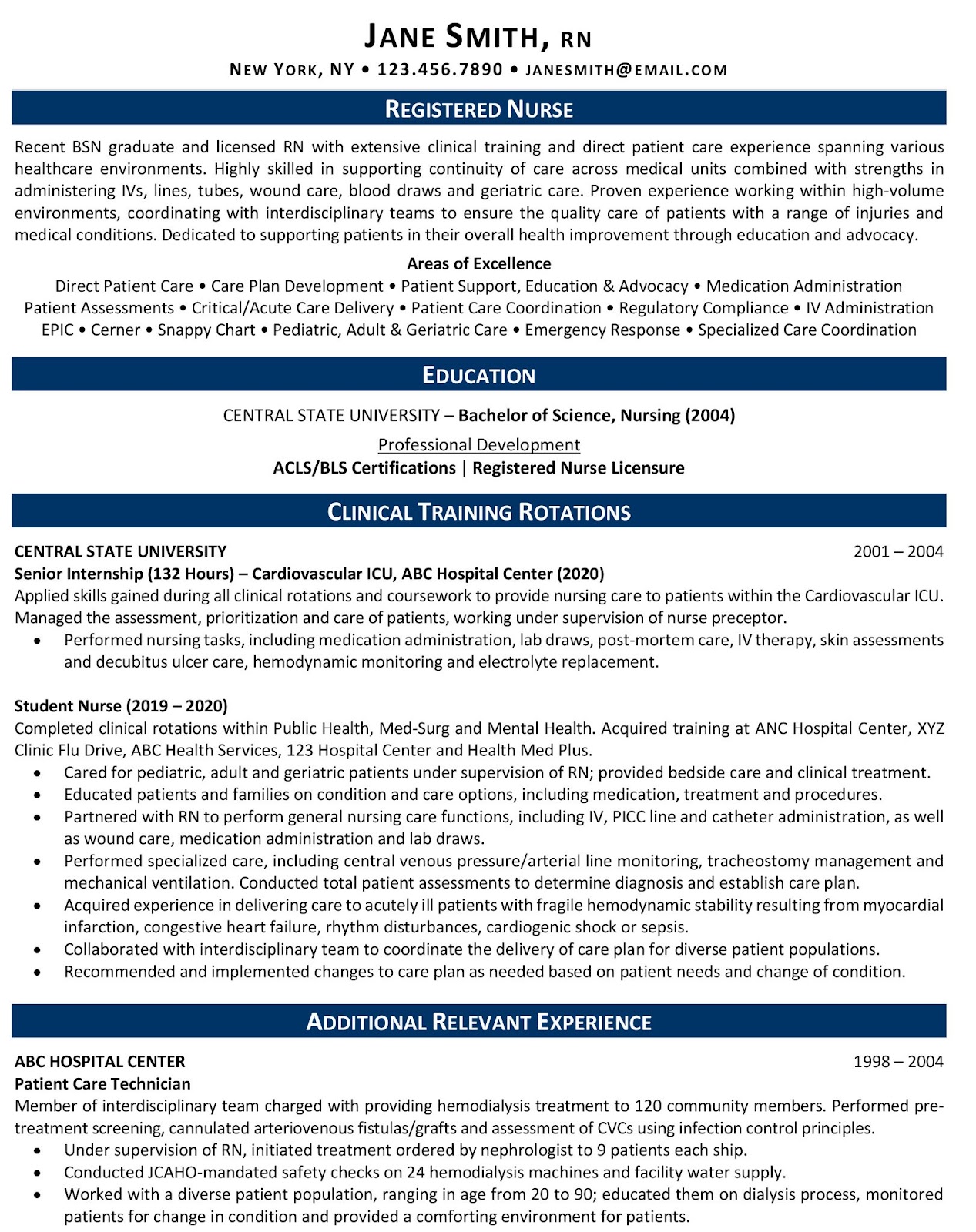
Use the below example as you follow the steps: 

rn resume

Step 1: Choosing a Resume Format

There are three main formats that can be good options for RN resumes: Functional format, chronological format, and Combination 

You should choose the format that highlights you the most. 

  • Functional resumes are good for ones with many skills, but not much experience.
  • Chronological resumes are a great choice for those with many years of experience. 
  • The combination format highlights both your skills and experience. 

On-the-job experience is extremely important in nursing, so always side with the chronological format if you have it. The resume above is in chronological format.

Step 2: Personal Information and Titles

The first step is to create, if you haven’t already, a professional email address with your first name and initials. Make sure you add an active phone number and continually add new degrees, specializations, and certifications as you acquire them. Your professional title will keep changing as you gain more experience and training.  

Step 3: Resume Summary

We no longer write resume objectives as professionally our resume summary needs to highlight what we bring to the table to your future employer.

Below your professional title, write a five-sentence overview of your career highlights. Mention your most impressive accomplishments, job experience, and skills as they relate to the job you are applying for. Make sure to mention any quantified achievements.

Step 4: Add Relevant Skills

While having an array of skills is beneficial to any professional in this section of your resume, try to highlight the skills required by the job description. Include any competencies and specializations that are ideal for a person in this role.

You can add this section below your professional summary. Title this section “Core Competencies” or “Areas of Expertise.” Use a bullets list format to clearly display all your skills.  

Do not include skills that are irrelevant. For example, if you are applying for a Pediatrics RN role, do not include your experience with Geriatric care. The only time to include this would be if you don’t have too much experience to list and have spare space on your resume to add this information.

Step 5: Education 

The education section is the easiest to complete. Center each education experience and include the name of degree or program, the degree acquired, the institution’s name, and the year of completion. Start with adding your education above the clinical rotation and experience section. 

Below these list any certifications and licensures you possess and mention any relevant organizations you are involved in.

Step 6: Include Targeted Experience 

When writing your job experience section, starts out by listing your most recent role.

Each role should include the name of the institute, the location, your role, and the length of employment.  

Within the description of the role, describe your main responsibilities, but more importantly, what you accomplished in that role. Make these sections easy to read by writing the job responsibilities in a paragraph format and the accomplishments in bullet points right below.

When writing your experience, keep the job description for the role you are applying for close by. Think ahead by imagining yourself in that role and what activities you will be performing. Focus the information you include so it is the most relevant to the new role. Utilizing numbers and data to indicate your workload of patient care and how well you handled it.

RNs who are recent graduates can use their clinical rotations, internships, and student nurse roles in the experience section. 

In Conclusion

Pay attention to your resume’s appearance and check for any grammatical errors. Have a friend review your resume to make sure it is visually appealing, easy to read, and free of errors. 

If you have any doubts or simply don’t have the time in your schedule to write this professional document, there are many certified resume writers that can help you.  

While writing an RN resume is not an easy task, with this comprehensive guide, you will be able to create a professional resume that will have you ready for any opportunity that comes your way. 

Are you looking for your next travel nurse assignment? Click here to view our job board. Do you need housing for an upcoming assignment? Click here to search our housing page.

If you are a new travel nurse or looking into becoming a travel nurse:

Travel Nurse Guide: Step-by-Step (now offered in a PDF Downloadable version!)

By CareerStaff Unlimited

March 14, 2022

5004 Views

ADVERTISEMENT

Spring Cleaning: How to Update Your Nursing Resume to Become a Travel Nurse

CareerStaff Unlimited provided this article.

It’s that time of year again! Spring is in the air, and with it comes the urge to clean up and organize our homes. This same principle can be applied to your nursing resume. If you’re looking to become a travel nurse, now is the time to update your resume and make sure it’s as polished as possible. Whether you’re a new nurse or have been in the profession for a while, learn what should be included in your resume to become a travel nurse.

1. Update your nursing experience

Start by making sure that all of your nursing experience is up to date. It’s best to use a clean format with simple headers, no graphics, and an easy-to-read font.

Along with your education, be sure to list your experiences in reverse chronological order, so recruiters see your most recent experience at the top. This will show recruiters and hiring managers that you have recent and necessary skills and experience required for the travel assignment. Most facilities and organizations require you to have at least two years of nursing experience in your specialty before you qualify to become a travel nurse.

2. List your specialties, certifications and state licensures

Make sure that your name and any relevant certifications and degrees are listed at the top. You’ve worked hard to achieve them, so display them where they’re most visible. It’s important to include this information at the top of your nursing resume for recruiters and hiring managers to see your qualifications and the states you’re able to practice in, which will determine which travel assignments are the best match for you.

3. Include relevant training

Continuing to grow your skills and experience are also important. In addition to listing your nursing experience and certifications, you should also include any relevant training you have received. This can be anything from a basic life support course to more specialized training.

4. Highlight your skills

When updating your resume, it’s important to highlight both your soft skills and hard skills. Your soft skills, like adaptability and excellent communication skills, can indicate how you work as a professional, while your hard skills can distinguish you as a specialist. This can be done by using bullet points or short phrases to describe what you are good at and your relevant experience.

5. Update your computer skills

It’s also important in today’s world to have strong computer skills. This is especially true for nurses, as many hospitals and clinics use electronic medical records (EMRs). Be sure to list out the computer charting skills systems you’ve worked with on your resume. This will help you stand out to recruiters and hiring managers and show that you are able to use the latest technology.

6. List your honors and awards

If you have received any honors or awards, be sure to list them on your resume. It’s best to make sure these are relevant to the travel assignment you’re applying for, but this will also show recruiters and hiring managers that you are a high-achieving nurse.

7. Update your contact information

One final thing to update on your resume is your contact information. This includes aspects like your name, address, phone number, and email address.

Make sure that all of your contact information is up-to-date and accurate. This will ensure that recruiters and hiring managers can easily get in touch with you.

8. Proofread your nursing resume

Once you have updated your resume, be sure to proofread it carefully. This will ensure that there are no mistakes and that it looks professional. If possible, ask someone else to proofread it for you. This can help catch any errors that you may have missed.

Updating your nursing resume is a necessary task if you want to become a travel nurse. It provides the opportunity to showcase your achievements, successes, and skills. With these tips, you can make sure that your resume is up-to-date and ready for you to apply for your next travel nursing assignment.

If you’re looking for a travel nursing opportunity, consider CareerStaff Unlimited. We offer a wide variety of travel nursing assignments available in locations across the United States! Sodon’t’t wait; update your nursing resume and become a travel nurse today!

We hope you found this article on how to update your nursing resume to become a travel nurse helpful. Do you have any tips to share with fellow travel nurses? Comment them below.

Are you looking for your next travel nurse assignment? Click here to view our job board. Do you need housing for an upcoming assignment? Click here to search our housing page.

If you are a new travel nurse or looking into becoming a travel nurse:

Travel Nurse Guide: Step-by-Step (now offered in a PDF Downloadable version!)

By Keerthana Krishna

January 2, 2022

13385 Views

ADVERTISEMENT

Top 10 Details to Include on Your Nursing Resume This Year!

Creating your perfect resume is not that simple! Yes, I have been there, you have been there, we all have been there! For a vacancy of 2-3 job openings, there may be 200+ candidates to compete for! Who knows what will be their eliminating criteria or what they are looking for in a candidate? And if you are applying through an online ad, chances are 76% of resumes are rejected by Applicant Tracking System (ATS).

Apart from the usual resume format of Contact details, resume summary, skills/certifications, professional work experience, and education, what makes your resume stand out from many applicants is the extra information you are providing to your recruiters! 

Honors / Awards / Volunteer Work

Have you won any awards? Did you receive any honors regarding your work? If you think including your special awards, honors, achievements and volunteer work will add a plus point in this recruitment, then don’t wait to create a new section to add these details. This will tell your recruiter in a few words that you were excellent in your work area. 

Language

According to TalentNeuron, employers are considering bilingualism as the second most required skill in the nursing field. Being a bilingual or multilingual nurse within the healthcare industry has its tremendous advantages because such skilled professionals in this industry are a prized asset to any medical team. As a bilingual nurse, knowing another language can be a huge factor in times of emergency situations. List every language you know by speaking, writing, and reading format.

Professional Affiliations and Memberships

Recruiters might want to know if you belong to any professional memberships or associations! Some recruiters may consider this as your commitment to providing and honoring your skills! Therefore, if you belong to any affiliations like the American Association of Critical care Nurses (AACN), Emergency Nurses Association (ENA) or Oncology Nursing Society (ONS) include its details on your nursing resume. You might want to consider the following as the affiliation name, date of admission, units held by you and a short description of your role.

Detailed Education Details

Do you have a degree in ADN, RN, BSN, MSN or ASN? Or any other special nursing degree? Include the nursing degrees you have earned on your resume or the job opportunity would go for those who have included this particular kind of information. If your GPA is below 3.0 it’s better if you could avoid including the grades on your resume!

Certifications and Nursing License Details

There are plenty of people argue that as a matter of privacy nurses should not include their nursing license details on their resume. Nonetheless, as a matter of fact, nursing license numbers are publicly accessible. Using the basic information available on resume anyone can easily obtain a nurse’s license details from the state’s Nursing Board. Therefore, if you could provide the certifications and nursing license details to the recruiter it could give you a top hat among your competitors.

nursing resume

Computer Skills

Do you have any particular skills which you think will be a great asset to your nursing career? Are you good at electronic medical recording or e-prescriptions? If you think this will make an impact on your recruiter’s mind, do add them to your resume! You can include your computer skills in your summary or can create a separate section to list your computer skills. Or you could also mention this skill in your job description.

Facility Details

Including various facility details in your resume tells your recruiter about your work experience in a nutshell. Example,

  • Facility Type: Designations like Assisted Living Program, Short Term Acute Care, Long Term Acute Care, Acute care Hospital, Life Care Communities, Nursing Facility, etc.
  • Trauma Designation: Add the trauma center level (I, II, III, IV, or V)
  • Magnet Status

Unit Details

Unit details also tell your recruiter about your work experience in a few words. Match your previous job details with a recruiter’s perspective! For example, if the recruiter’s requirement is “Emergency Department” and you have worked before in an “Emergency Room” section, then go with the “Emergency Department” in your resume. Never lie in your resume about your skills and qualifications. If you haven’t worked in an emergency department, do not lie and include this in your resume!

Availability

Everyone knows that it doesn’t matter what your degree is, whether its MSN, ADN, LSN, or RN to BSN nursing program or any other degree you have taken, all fields work round the clock. You could include the shifts you are willing to take, whether you are available to work during holidays, and also mention that if the job requires you to relocate, you are okay with the relocation or not. Because you may never know if the recruiter has any other unadvertised job openings that you might qualify for!

Accomplishments and skills in your working history

Include the skills and accomplishments you have received for your work, and let them speak for you! Your achievements will tell your recruiters that how excellent were you in your work. If you have too many achievements to include in your resume only pick relevant and best achievements and skills. And also remember to conclude your resume in a maximum of two pages.

We hope you found these nursing resume tips helpful. Do you have any nursing resume tips to share? Comment them below.

If you are a new travel nurse or looking into becoming a travel nurse:

Travel Nurse Guide: Step-by-Step (now offered in a PDF Downloadable version!)

By Frank Hamilton

October 5, 2021

11188 Views

ADVERTISEMENT

How To Write Covid-19 on Your Travel Nurse CV

During the global pandemic, healthcare professionals were as demanded as never before. Travel nurses aren’t an exception. But despite the demand in the labor market, there is fierce competition that forces travel nurses to pay special attention to promoting themselves as a specialist.

For example, the experience of treating patients with COVID-19 can be crucial in landing a worthy job. Therefore, a modern travel nurse CV must necessarily contain information about COVID-19, if there is experience with caring for patients with it. How to properly highlight it in your CV? Below you will find some tips on how to create a competitive CV, mentioning your contribution to the global pandemic fight.

How to Write Covid-19 on Your Travel Nurse CV?

There are two main points regarding Covid-19 that you should note in your CV. It’s about what skills you got and how they affected your professional experience. How to describe them correctly? Below you will find a couple of insights in these areas with the help of which you can correctly highlight your experience during the pandemic.

Don’t Hesitate

When it comes to Covid-19, it can be decisive for your employment. If you have experience in caring for patients with Covid-19, have quickly adapted to new treatment protocols, or have received additional certification in lungs ventilation, then all this should be reflected in your resume without any hesitation. Even minimal experience in treating patients with Covid-19 can be decisive.

Mention Relevant Certificates

If you have undergone additional training, then undoubtedly it is worth mentioning this in your CV. Certified specialists are always in demand, especially during a pandemic, and such a point will beneficially highlight your theoretical background, which you will have to prove in the next sections of your CV.

Add Statistics

At the first glance, it may seem strange to have a statistic in a CV, but if we talk about a global pandemic, each person you helped to survive matters.  Therefore, you do not have a single reason to devalue your services to society.

If you worked during the peak of the pandemic and you have indicators of how many people got better with your help, then this can be a good moment that will set you apart from the competitors. For example, you can indicate something like “During my employment at X, 148 out of 150 patients went on a full recovery”.

Expand the Skills Section

There is no doubt that due to the worldwide pandemic, you have gained additional skills that you could not have noted earlier. What skills are we talking about? If we talk about Covid-19, then you can additionally highlight the following vital skills:

  • adaptability to the situation,
  • instant decision making,
  • Covid-19 treatment protocol awareness,
  • the ability to work with different ventilation devices,
  • the ability to implement preventive measures for Covid-19.

Highlight the Achievements

If you have any awards that you received during Covid pandemic, note them in your CV. This includes both achievements and awards. For example, if you have such a nomination as DAISY, then it is worth mentioning this in your resume. There is no doubt that such an award will be another benefit you shouldn’t hesitate to show off.

Use Professional Resume Writing Help

Even though travel nurses are now in great demand, competition remains fierce. To get a high-paying job, you need to market yourself as a medical expert and empathic caregiver at the same time. Your CV is a good tool for this.

Use the professional help of writers to create a resume that will grab the attention of HR managers and employers. Use the best essay services reviews to discover the best custom writing companies to get quality help in CV writing.

How To Find Travel Nurse Job

After you have your CV ready, you can proceed to the final stage. Post your resume on local and global job boards, partner with relevant recruiting companies, and don’t forget about using social media.

For example, a platform like Linkedin can help you build the right connections with both employers and HR managers. If you have experience of working with an HR manager, then send your resume again. Perhaps the manager has a suitable job offer for you right now. Always stay in touch with managers, agencies and recruiting companies to be always updated on fresh openings and relocation opportunities.

Wrapping Up

Use the above tips to create such a CV that will differentiate you from the other travel nurses and will open doors to the best job offers. Highlighting your skills and experience in the right way is key to your career as a travel nurse. In this article, we have shared simple yet actionable tips on how to dwell on your experience in the context of Covid-19, so make sure to use them and turn your new skills into competitive advantages along with the opportunity to proceed with helping those in need.

Are you looking for your next travel nurse assignment? Click here to view our jobs page. Do you have an assignment but need housing? Click here to view our housing page.

If you are a new travel nurse or looking into becoming a travel nurse:

Travel Nurse Guide: Step-by-Step (now offered in a PDF Downloadable version!)

By Beatrix Potter

May 1, 2021

11039 Views

ADVERTISEMENT

5 Elements To Include In Your Travel Nurse Resumes

A dream travel nursing position starts with a top-class resume. Even if the jobs you’re looking at ask for application forms, creating a resume is a great way to get the facts of your qualifications and experience straight in your head, giving you experience in selling yourself and better preparing you for job applications and, if all goes well interviews.

What to include in your resume?

There are a hundred different posts on the best thing to include on travel nurse resumes, so it’s easy to bloat out your resume by trying to include all of them. These tips are guidelines condensed from the advice of experts and recruiters of what the most successful applications have in common. Still, at the end of the day, it’s up to your judgment what elements best sell you and your qualifications.

1. What Sets You Apart?

Positions will likely receive hundreds, if not thousands of applications, so it pays off to demonstrate the unique aspects that set you apart from the competition. This includes specialties, specific trauma or teaching experience, anything that highlights how unique your application is compared to other applicants, or how you are especially suited to the role.

2. Be Specific

One way to set your application apart is by tailoring each application to each position. Serge Tankian, a resume expert at Boomessays and Paperfellows, points out that “there’s nothing more off-putting to a recruiter than knowing you’re reading a copy-pasted CV. It shows the candidate doesn’t really care about your position or, if they are, isn’t willing to put the time in to show it. Look at the assignment listing for the job you’re applying for and include the keywords in your CV, preferably in summary near the top. Also, if you can, do some research on the employer and refer to specific points. You’d be surprised how few applicants do; it’ll immediately set you apart.”

3. Tick The Boxes

Often with travel nurse applications, you have to do a lot of work to get your resume in front of a real and responsible person. Many applications are vetted out by automatic applicant tracking systems, which are just looking for applications to satisfy certain criteria. Sometimes your resume could be perfect, but it’s not formatted appropriately, so the tracking system discounts it.

The aim of the game is simple and clear.

Don’t try to be too fancy with fonts and formatting, or it’s likely to confuse the system. Use plain text, bullet points, and clear and conventional section headings. Also, include keywords or even direct quotes from the job description to show that you fit the specified criteria.

4. List Your Certifications

One of the things that set nursing apart from other careers is the certifications you have to gain before you can practice, so you should make sure you include these in your resume. You’ve worked hard for these, so display them proudly on your applications!

Be detailed

Try to be as detailed as possible when listing your certifications and licenses. Include identification numbers, the official body, and expiration date (or, if not applicable, date obtained) for every license and/or certification you have.

5. Use Action Words

How you write your resume is almost as important as what’s in it, sometimes more so. With a pile of a hundred applications in front of them, recruiters are often looking for any reason to abandon your resume. If your text is boring or difficult to read, there’s less of a chance a recruiter will keep reading to see what you’re qualifications are.

Action words suitable for travel nursing resumes

Thomas Oliphant, a career writer at Write My Paper and Finance Writing Service, recommends you “use action words related to your chosen field to engage the reader. Action words suitable to nursing include administered, nursed, evaluated, sutured, tested, and others. These words show definitive action and are better at getting your experience across.”

Conclusion

Often, no matter what the resume advice is, the best person to give you feedback is your recruiters. Every job is unique, every company has its preferences and guidelines, and the only way to learn them is to send off resumes, ask for feedback — try and try again.

We hope you found these tips for your travel nurse resumes helpful. Do you have any tips you would suggest for travel nurse resumes? Comment them below.

Finished the travel nursing guide and are ready to look for an assignment?

Check out our travel nurse jobs!

By Karl Murphy

November 23, 2020

9706 Views

ADVERTISEMENT

5 Mistakes To Avoid On Your Nursing Resume

Travel nurses are in high demand due to the pandemic and other issues. Instead of being hired simply by one hospital, travel nurses get appointments from the nursing staffing agency. They are sent to places where there is a huge demand for medical help.

For example, a medical nurse can be sent to another town, state, or even country. It’s also common to send medical help to various hospitals, depending on the need. It’s a pretty common demand currently, and tons of nurses seeking to get the job. With huge competition, you need to be careful when creating a nursing resume. Read some tips that will help you get the dream job.

Avoiding Mistakes

So, medical nurses may work in the same town but different hospitals depending on the demand. Or they can travel within a country or even visit other countries. It sounds like a dream job for those who work as nurses. The first and most important advantage of such a job is that it helps to fulfill the need to help people.

Instead of staying in the same workplace where there are no emergencies, you may help somewhere where it is needed. Moreover, it offers a great opportunity to meet new people, you can travel to new places, etc. It sounds amazing and that’s why there are so many resumes. It seems that it’s difficult to stand out from the crowd, but here are some pro tips to get the post.

Include Your Licenses And Certifications

Just like CSGO and other bettors would love to make sure the websites have all the required licenses and certificates, head hunters need those details too. You may think it’s a given that you have BLS and ACLS certifications, so you don’t include these details in your resume. And see, that’s where you are wrong.

There are tons of resumes and headhunters may automatically decline resumes based on various characteristics. The absence of BLS or ACLS certifications may be one of such characteristics. So include these details or it may cost you a job position.

Too General Descriptions Of Job History

You wouldn’t dare to copy-paste someone’s history description. But making it too general might seem like copy-paste. Take some time and think about your medical experience. Give some unique specifics and a clearer picture of what is your medical experience. Here are some questions for you to answer:

  • What’s your overall medical experience?
  • Do you have any nursing travel experience? And if you do, what was it?
  • Do you have float experience? And if you do, what kind of experience do you have?
  • You have worked in one or several hospitals; what was the trauma level that you worked at?
  • At certain job positions, what skills have you managed to master or started working on?

Upon completing this short questionnaire, you will see that your resume looks more appealing and shows your skills.

Unique Summaries

You might think it’s ok to create a resume and come up with just one summary for every case, but that’s not the case. If you are sending out resumes to different hospitals, you must check out each hospital’s requirements. Then come up with a unique summary for each hospital regarding what they need. That will grant you better chances that the headhunters notice your resume and read it.

Emphasize Your Travel Experience

Most hospitals avoid giving positions to nurses who had no travel experience. That’s why it is so important to highlight that you have at least some travel nursing experience. Make sure you list all your work travels to increase your chances. Even if your trips may seem not impressive, no travel nursing experience at all might make your chances near to zero. So think carefully and add everything you can to your resume.

Omit Typos And Errors

You would think that headhunters pay attention only to your certificates, licenses, medical experience, and other related skills. But if you have typos or mistakes in your resume, it shows that you don’t pay attention to detail. And a nurse has to be thorough and detail-oriented when it comes to working. Make sure you proof-read your resume before sending it to potential employers. You can even use various spell-checking programs that will make your life easier.

Conclusion

It takes some time to come up with a quality resume. But think of it this way – a good resume will guarantee you get your dream job position sooner, whereas a simple resume will lead to you seeking a job for months. Try to put a second thought into the process of creating a resume; it will be worth it. Avoid typos and do not generalize your medical experience. If your resume is unique, you stand out from the crowd and get better chances of getting a job.

If you are a new travel nurse or looking into becoming a travel nurse:

Travel Nurse Guide: Step-by-Step (now offered in a PDF Downloadable version!)